



MU reaches the Top 3 with a spirit absent under Amorim's tenure



MU has risen to 3rd in the Premier League. The shift involves more than just tactics or players; it's about mentality. The quality that was largely missing during Ruben Amorim's era has now become the cornerstone of MU's resurgence.
Under Ruben Amorim, whenever MU conceded first, the atmosphere at Old Trafford often turned gloomy. In 20 Premier League matches this season under the Portuguese coach, MU recovered a mere 7 points from losing positions. A sense that "the game was over" seeped from the stands onto the pitch. This was not merely a tactical issue, but a collective psychological one.
The remarkable transformation of MU
The difference under Michael Carrick is clear in the numbers. In just his first 7 games in charge, he helped the team earn the same number of points that Amorim's side had taken over many months. MU conceded first to Arsenal but still won. They went behind to Crystal Palace in the 4th minute and still fought back to victory. Against West Ham, they salvaged a point in the dying seconds after falling behind. Even after squandering a 2-0 lead against Fulham, the team rallied to secure all three points in stoppage time.
These are no longer isolated moments of inspiration, but a consistent trend. When Bruno Fernandes coolly equalized from the penalty spot against Palace, there was no visible panic. When Benjamin Sesko rose decisively to head home the winner, it was the image of a collective that believed they deserved to control the match.
The transformation is also evident in the quality of performances. The 2-0 victory over Man City is rated as one of the best displays in the post-Sir Alex Ferguson era. MU is also the only team to have beaten Arsenal at the Emirates since last May. Six wins in a seven-match unbeaten run is not pure luck, but the result of a collective that knows how to react, adapt, and, most importantly, believe in itself.
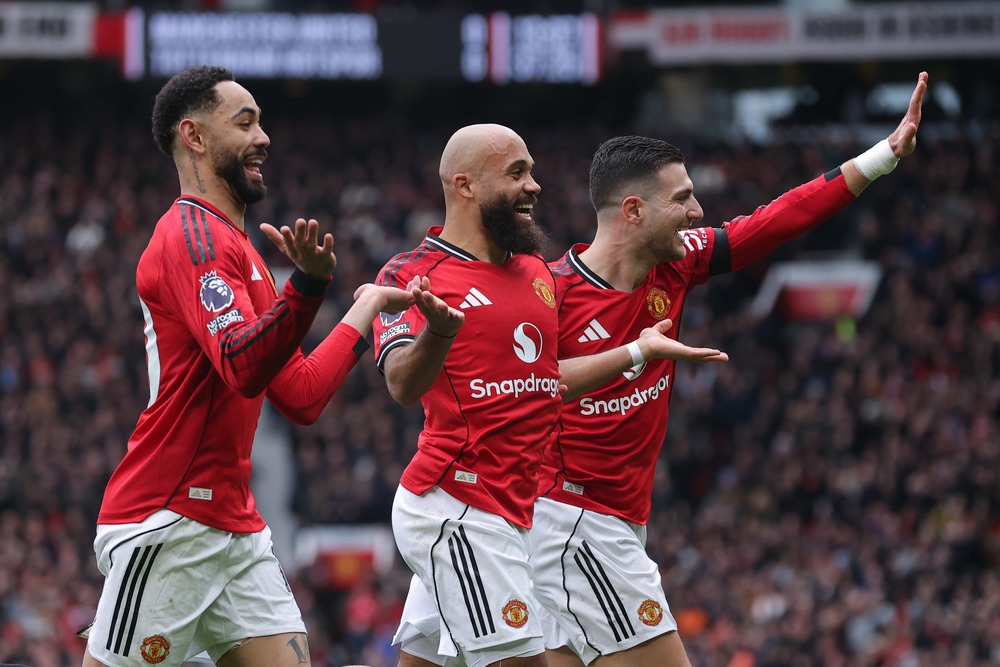
MU is changing rapidly under Michael Carrick
How has Carrick changed MU?
Spirit does not emerge spontaneously. It is cultivated through leadership and working methods. Carrick began with changes that seemed minor but had a profound impact.
He gives players Sundays off if they play on Saturdays, allowing foreign players more family time. Team meetings are shortened to 15 minutes to avoid being burdensome. Training sessions rarely exceed 75 minutes but are high-intensity and focused on quality. A streamlined schedule allows the whole squad to finish work before lunch, instead of dragging into the afternoon as before.
More importantly, Carrick altered the tactical structure. He abandoned the controversial 3-4-2-1 system to revert to a familiar 4-2-3-1, returning Bruno Fernandes to his favored number 10 role, reinstating Kobbie Mainoo to the lineup, and reaffirming Luke Shaw's position as left-back. This adjustment not only optimizes individuals but also restores balance.
On the training ground, he encourages assistants like Steve Holland, Jonathan Woodgate, and Jonny Evans to debate and contribute ideas, rather than waiting for orders. Players receive personalized work, from defenders practicing defensive positioning and clearing headers to forwards refining finishing in tight spaces. Benjamin Sesko is a clear example: 7 goals in 8 matches, directly contributing an additional 8 points for the team.
Carrick has also rebuilt a "family" atmosphere in the dressing room. He frequently monitors the youth teams, creating a bridge between the academy and the first team. The passionate celebrations from substitutes, the spreading determination from Casemiro before his departure, or the way the entire squad rushes to congratulate a teammate after each goal… All reflect a growing unity.
MU is not just changing its system. They are changing how they perceive themselves. And from that very foundation, 3rd place is no longer a surprise, but the inevitable outcome of a team reborn in spirit.


Wonderfulshortvideo
Kvaratskhelia and Ronaldo 🫶


🇪🇸 Spain 🆚 Argentina 🇦🇷
When Diogo Costa saved EVERY penalty he faced in the shoot-out 🤯🤯🤯
The movement is electric ⚡️
Never gives up 💪
Things you really love to see
Ahead of his 100th cap, Sir Keir Starmer had this message for Maro Itoje…
 Links
Links
 Contact
Address:123
Number:+123
E-mali:i123@gmail.com
 App
App