



Roki Sasaki Struggles in Spring Training Debut; Expanding His Pitch Arsenal Key to Securing Starting Rotation Spot


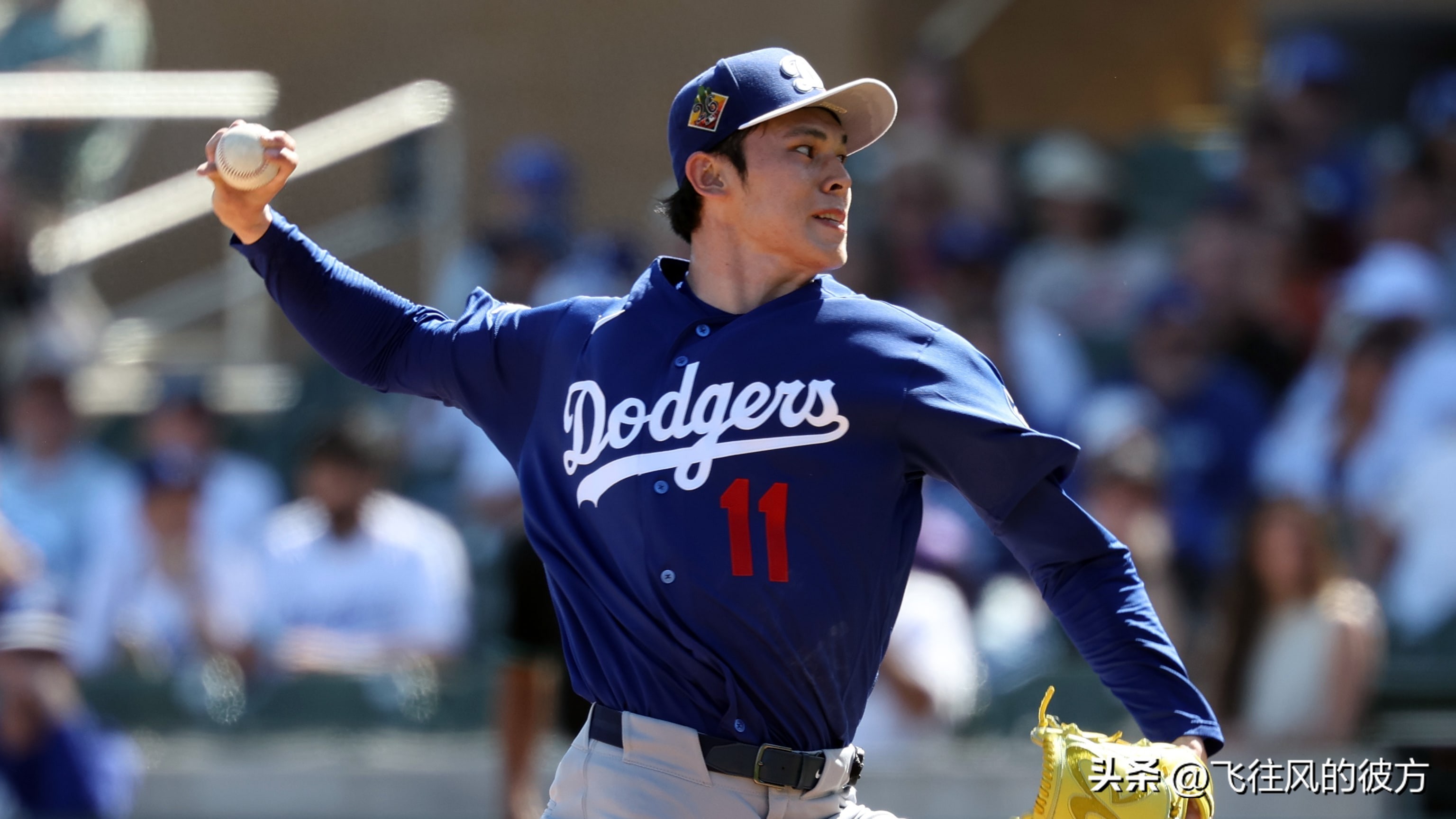
This was merely one spring training start among many ahead. However, these otherwise minor games might hold significant meaning for Roki Sasaki.
In today's spring training warm-up start, Sasaki struggled, pitching only 1.1 innings and giving up three earned runs. In the Dodgers' 10-7 win over the Diamondbacks, he experimented with newly practiced cutter and sinker pitches, but his control on the four-seam fastball faltered early.
Adding one or two new pitches to Sasaki’s repertoire is seen as crucial for his long-term role as a starter. In the short term, refining his current pitches, especially his fastball, might be just as important.
“The key is that he has to pitch off his splitter. He can throw quality pitches or shorten the inning,” said manager Dave Roberts. “Then pair that with a fastball that he can control. And then comes the third pitch we mentioned.”
Sasaki’s four-seam fastball and splitter form a devastating combination, but lacking a reliable third pitch made him predictable last year. When he couldn’t locate his fastball for strikes, hitters would lay off the splitter. Conversely, when his splitter wasn’t occasionally in the zone, batters targeted his fastball.
Today’s game demonstrated how expanding his pitch arsenal could make Sasaki more dangerous, but he also needs his fastball to perform at its best.
In the first inning, Sasaki allowed four of the first five batters to reach base, surrendering three hits and a walk, resulting in three runs. Early on, he called his own game plan, relying heavily on his four-seam fastball with occasional cutters until facing Ildemaro Vargas, whose two-run double dealt significant damage to Sasaki’s outing.
After that, catcher Dalton Rushing took over pitch-calling duties, and Sasaki began mixing his signature splitter with occasional sinkers. From that point, he improved markedly, striking out the last two batters of the first inning and the first batter of the second.
The Dodgers had hoped Sasaki would pitch two innings, but after issuing his second walk, his outing ended. He threw 36 pitches, recording four outs with 17 strikes.
“Honestly, today was the first time I felt his pitching mechanics broke down,” Roberts said. “It seemed like he was trying too hard.”
Although Sasaki ended last season in good form, he still had things to prove entering spring training. The once highly touted "Reiwa Monster" had a rough start in his rookie year, posting a 4.72 ERA over his first eight starts before landing on the injured list with a right shoulder contusion.
It wasn’t until he took on an unfamiliar role that Sasaki rediscovered the form he was praised for in Japan’s professional league: as the Dodgers’ postseason closer, he delivered fiery performances, improved his release, and regained triple-digit velocity that he lacked earlier in the season.
Sasaki did not hit triple digits today but reached a top speed of 98.6 mph, with an average fastball velocity of 96.9 mph.
“For me, pitching mechanics are very important to increase velocity,” Sasaki said through a translator. “So I want to focus on adjustments between my two outings.”
Sasaki’s bullpen role was always temporary. This year he is slated to be a starter, but there remains a sense that he must fight for a spot in the Dodgers’ starting rotation, even though it seems like his rightful place.
“The way he came into spring training camp has many promising aspects,” Roberts said earlier in spring. “Personally, I expect him to make the rotation. But looking ahead, he still needs to deliver strong performances.”
Balancing development and competition during spring training is challenging. This places players like Sasaki under intense scrutiny, even in games that don’t carry much weight.
“This is the growth path of a 24-year-old trying to pitch and develop in the major leagues,” Rushing said. “It’s not easy; every player needs to grow once they get here. The more you grow, the better you become.”
At this time of year, teams consider more than just game stats when deciding the best lineup; overall performance is equally important.


Wonderfulshortvideo
practicing healthy communication at the ballpark 🫶


He's baaaaaack.
Cue the trumpets ... it's almost time to enjoy the Sho!
“There isn’t a single sorcerer who doesn’t know of Satoru Gojo” 🤣
Baseball is back!
It’s good to have you back, Alex. 💙
Yoshinobu showing off his new glove and matching cleats. 👀
 Links
Links
 Contact
Address:UNIT 1804 SOUTH BANK TOWER, 55 UPPER GROUND,LONDON ENGLAND SE1 9E
Number:+85259695367
E-mali:icecmxtdaf@gmail.com
 App
App


